Family Tree Vocabulary in English

A family tree maps how relatives connect. Family Tree Vocabulary in English: Words and Activities for Kids teaches children to describe parents, siblings, grandparents, and cousins. Begin with relatives your child knows, then add branches one at a time. The goal is not one family pattern, but language for naming important people, asking questions, and answering confidently.
📥 Family Tree Vocabulary Practice
Read, match, write, and use family words with confidence.
Leave your email — we'll send the PDF to your inbox.No spam — the PDF plus one short reminder. Unsubscribe anytime.
Family Words to Teach First
Begin with four to six core words: family, parent, mother, father, brother, and sister. Introduce sibling when your child understands it means brother or sister. Family Tree Vocabulary in English: Words and Activities for Kids works best when each word connects to a photo, drawing, or familiar name.
Children may prefer home names such as Mum, Mom, Mummy, Dad, Grandpa, or words from another language. Keep them, adding the English relationship instead of replacing them. A child might write “Tata — grandfather” or “Abuela — grandmother.” This bridge respects both languages and family speech.
Putting Relationships into Sentences
Teach one sentence frame before requesting a full description. Try “This is my grandmother,” “He is my uncle,” “She is my cousin,” and “They are my parents.” Children then change one word while the sentence stays stable.
Next ask, “Who is this?”, “Is this your sister?”, and “Who is older?” In Family Tree Vocabulary in English: Words and Activities for Kids, questions turn the diagram into conversation. Let your child share only comfortable facts.
Older learners can connect ideas with because, but, and while: “My cousin lives in France, but we speak online,” or “I visit my grandparents while we are on holiday.” They can compare generations: “My mother is my grandfather’s daughter.” These sentences test vocabulary and family-tree logic.
Three-clue Family Challenge
Choose one person on the family tree and give three clues without naming the relationship. For example: “She is my father’s sister. She lives in another city. She has two children.” Your child answers, “She is your aunt,” then creates the next clues.
Activities for Different Ages
For school-age kids, use a small tree with no more than six familiar people. Draw circles, add photos if the family agrees, and say each word aloud. Play “Point to the…” with “Point to the brother” or “Point to a grandparent.” Finish while attention remains strong.
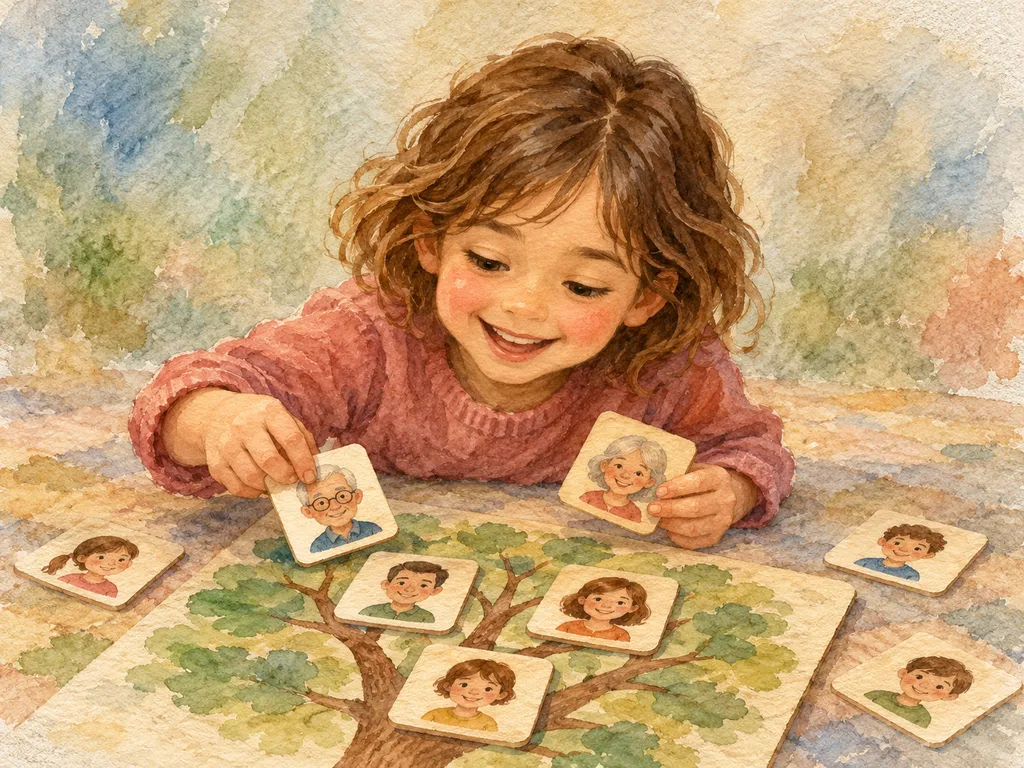
For school-age kids, let the child build the tree with cards. Write one person’s name on each card and one relationship on the back. The child places cards, checks labels, and makes one sentence about each person. Family Tree Vocabulary in English: Words and Activities for Kids can become a guessing game: remove one card and ask which relationship is missing.
For school-age kids, expand beyond labels. Learners can interview a willing relative, compare two branches, or write a short family profile. Add stepfamily, half-sibling, adopted, guardian, or only child when relevant. Protect privacy: an invented family from a book or film works when personal details feel sensitive.
Practice in Everyday Life
Brief reviews fit breakfast, car rides, or pre-lesson time. Show three family photos and request one sentence about each. Another day, sort word cards into “same generation,” “older generation,” and “younger generation.” New tasks keep familiar words active.
Stories provide practice without formal drills. After a family relationship appears, ask, “Who is this person?” or “How are these two people connected?” Your child can draw the story’s family tree, especially when that family differs from their own.
In LearnLink lessons, tutors can model vocabulary, correct sentence patterns, and match challenges to age. At home, praise meaning before correcting each small error. Then model the correct form naturally: if your child says “He my cousin,” answer, “Yes, he is your cousin.”
Common Mistakes and Inclusive Choices
Children may confuse cousin with brother or sister because all can be close in age. Return to the link: a sibling shares a parent with the child; a cousin connects through an aunt or uncle. Practise grandparent and grandparents so the final s signals singular or plural.
Possessives need care. “My mother’s brother” means the brother of my mother; “my mothers” means more than one mother. Mark the owner and relationship with coloured pencils, then read outward from the owner. Older children can compare “Anna’s cousin” with “Anna and Leo’s cousin.”
A family tree describes a family without judging it. Children may live with one parent, two parents, grandparents, guardians, foster carers, or stepfamily members. Families may use aunt and uncle as warm titles for close adults. Ask which words the child uses; do not demand private explanations. Success means describing chosen relationships accurately and respectfully.
- Use inclusive labels like caregiver, stepparent, and guardian during family tree practice.
- Ask children aged six to nine which family words fit their lives.
- Practice singular and plural forms with five illustrated family member cards.
- Correct gender assumptions by discussing two diverse picture books together today.
- Let children choose names and relationships for a flexible family tree.
When a word has several meanings or pronunciations, Cambridge Dictionary is a useful check before turning it into child-friendly examples.
Frequently Asked Questions
How Many Family Words Should My Child Learn at Once?
Start a young beginner with four to six familiar words. Review through pointing, matching, and short sentences. An older child may handle eight to twelve words when relationships are known. Use Family Tree Vocabulary in English: Words and Activities for Kids as a menu, not a test; steady recall beats finishing every word in one session.
What If Our Family Does Not Fit a Traditional Family Tree?
Build a diagram reflecting everyone your child calls family. Include one parent, guardians, step-relatives, adoptive relatives, foster carers, or close adults with family titles. A “family circle” can replace a branching tree. Ask which names and relationship words feel right; never require private details.
Should My Child Translate Family Words into Another Language?
Translation can support a multilingual beginner, but should not become the only task. Pair the home-language word with a photo, the English word, and a short sentence. Then practise English recognition without translating each time. Children speaking two or three languages may reserve different family titles for different relatives; preserve those distinctions.
How Often Should We Practise Family Tree Vocabulary?
Practise briefly several times across the week, not in one long session. Two or three minutes covers a photo prompt, card sort, or three spoken questions. Return after a gap and mix old words with one or two new ones. Using a relationship word in a fresh sentence shows stronger learning than repeating a memorised list.
A short one-to-one lesson can show what level and pace fit your child — book a trial English lesson.
Stay updated on our latest tips and resources by following us on Instagram LearnLink.